The evidence, on the record.
Real screenshots of the app the engine generates, compiler-proven conversion ledgers, and case files on the real, gnarly reference applications Salesforce ships to the world. Every number here is engine output — re-run the corpus and the verdict is identical.
The record your team lives in every day — rendered by the meter you rent, and by the app you own.
Details
Activity
Follow up on proposal…
Send updated quote
RE: Widget pricing
The meter runs while you work: per-seat license, per-seat AI add-on, storage overages — and the UI, the logic, and the data model all stay Salesforce's.
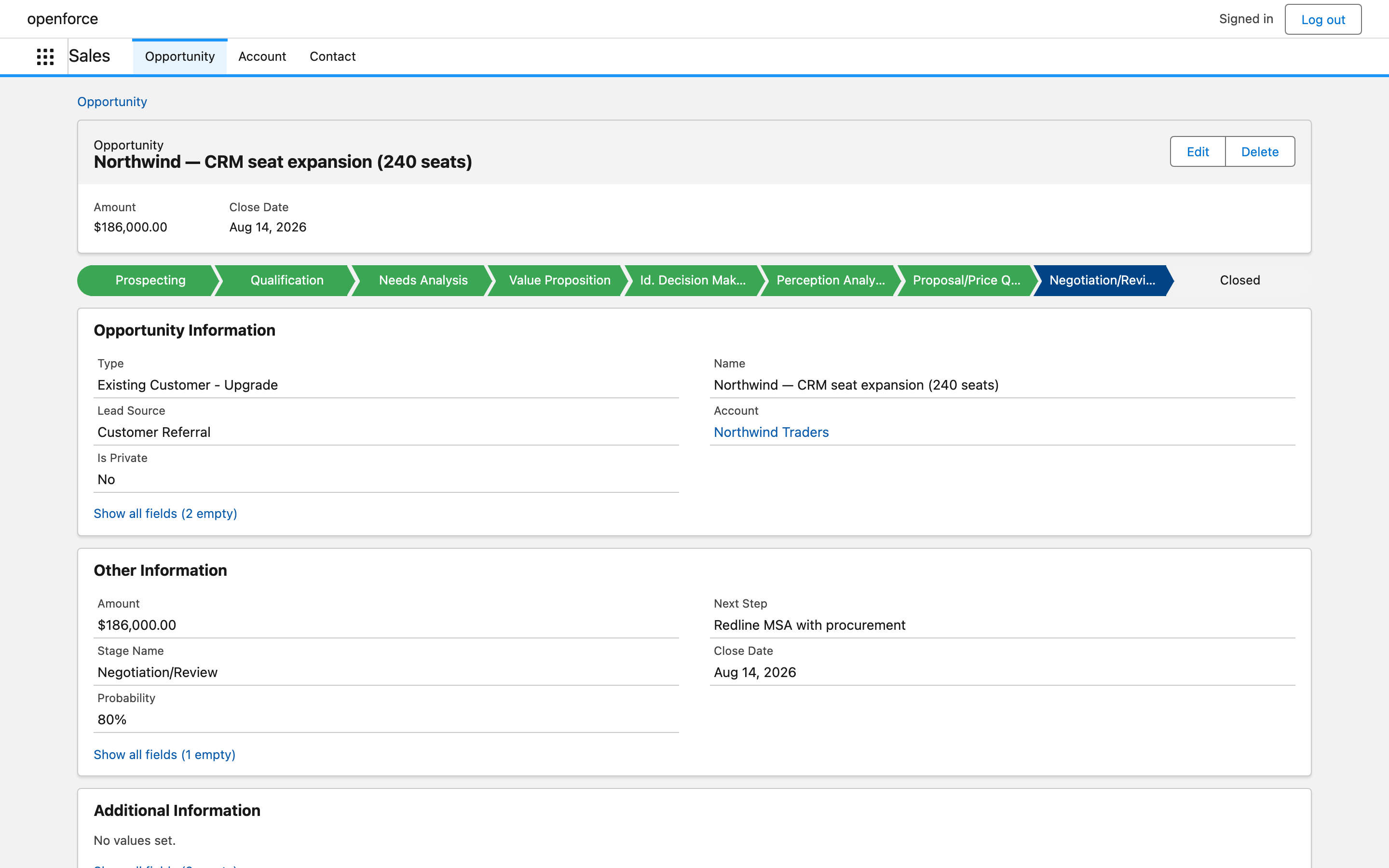
Real, unedited engine output — not a mockup: a vanilla org’s standard Opportunity, retrieved and transcribed by the engine, deployed to PostgreSQL + Fastify + React with JWT login on a real server, then screenshotted. Every object gets list, detail, and edit views; validation rules become Zod, sharing becomes Postgres RLS. See the edit form and login screen from the same app.
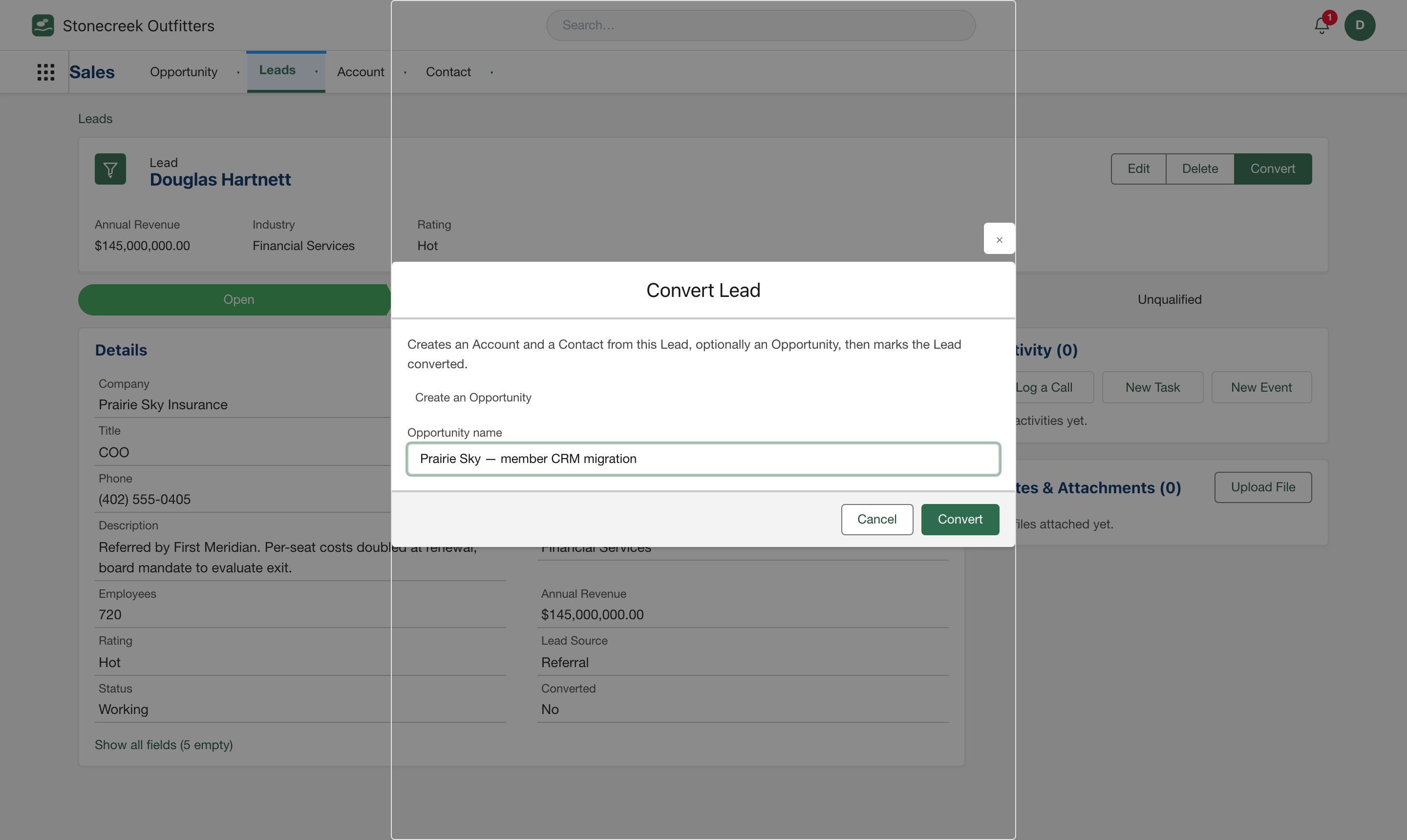
Salesforce’s convert semantics, compiled: one transaction creates the Account, Contact, and optional Opportunity, then locks the lead. A second convert is refused. Unmapped fields are reported, never dropped silently.
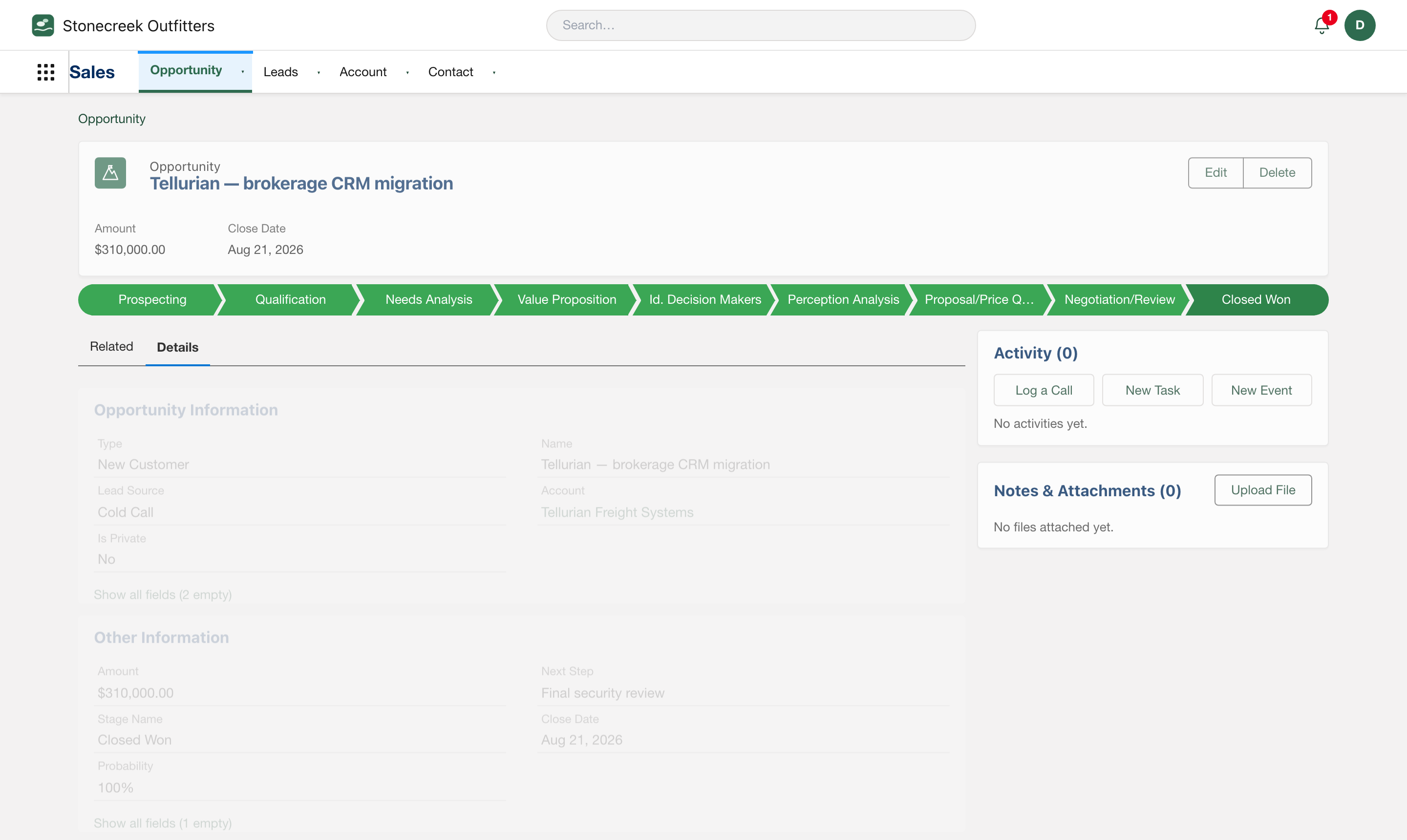
The stage rail is your org’s own Opportunity picklist — Prospecting through Closed Won — not a template. Work the pipeline exactly the way your team already does. See the leads list and lead record from the same app.
Three claims a competitor can't make without a compiler. Every number below is engine output on six public benchmark orgs — re-run the corpus and the verdict is identical.
When we say converted, a compiler said so.
The LWC → React converter is a deterministic directive table — no LLM, no guesswork. A component earns the word converted only after a real strict-TypeScript compile returns zero diagnostics. Everything short of that is named with its exact blocking construct and line.
Converted components compile inside the generated app against real React types — vite build green. Corpus: NPSP, EDA, PMM, dreamhouse, ebikes, easy-spaces, coral-cloud, apex-recipes, OutboundFunds.
The audit ships as source you can open.
- ✓Converted React components — dropped into the generated app, not a slide.
- ✓Per-component rewrite worksheets — done template vs. the behavior our engineer wires, with construct + line.
- ✓Integration endpoint scaffolds — each citing the original Apex callout site, file:line.
- ✓Rebuild checklists — the flagged work, itemized and owned by our migration engineers, not left on your desk.
Our quote shows its arithmetic.
Man-hours per workstream = measured quantity × a named, tunable rate — arithmetic shown, no invented numbers. Marked UNCALIBRATED until first-migration data calibrates it. Challenge any knob.
Also on the record: a per-file-type verdict ledger (challenge any excluded file), a per-class Apex deep run bucketed by measured complexity, per-page flexipage explanations, and custom labels resolved from your org's own metadata. Every figure here is engine output — re-run it and check.
Not toy orgs. The real, gnarly reference applications Salesforce ships to the world.
Coral Cloud Resorts
Salesforce's flagship demo org — code-heavy by design. Schema, UI, and data layer transcribed to a runnable app you own; every Apex class and LWC measured and priced, nothing glossed. 33.1% rebuilds deterministically today — the rest inventoried per item, then rebuilt by our migration team.
NPSP — Nonprofit Success Pack
One of the largest managed packages in the ecosystem — parsed without crashing.
PMM — Program Management Module
A Salesforce.org package running in live nonprofits today, not a demo — program management with 107 Apex classes, 43 LWC and Aura components, and an Experience Cloud volunteer community. Scored with no rounding, it rebuilds 54.1% deterministically right now; every remaining class is inventoried, each flag carrying a reason. This is the honest shape of a genuinely code-heavy org — and the flagged list isn't work left on your desk. It's the plan our migration engineers run for you: a person in the lead, AI as leverage, every item checked for parity against your Salesforce source and recorded verified, draft, or reworked before it ships.
17,650 lines of living Apex, parsed clean.
apex-recipes is Salesforce's continuously-updated reference library — the modern canon for how Apex is actually written. We ran the whole thing through the engine. Not a readiness score — a compiler proof: every class parsed, every query classified, nothing hand-waved.
Zero unparsed files. 87.8% of SOQL rewritten to Postgres automatically; the remaining flagged statements — dynamic SOQL, SOSL, cross-object subqueries — each carry a reason and are never silently dropped.
View the full deep-run report →A per-class verdict, not an average: 40 mechanical, 14 standard, 18 complex, 2 trivial, 68 test. The bucket is what scopes the engagement — you see the exact shape of the work before committing a dollar to it.
We never fabricate. The flags are the plan — and the plan is ours to run.
Vendors over-promise a magic 100%. We don't. Everything that deterministically converts is generated; everything that needs a human is flagged with a reason. That flagged list isn't homework for your team — it's the scoped work our migration engineers deliver: a person in the lead, AI as leverage, every item checked for parity against your Salesforce source and recorded verified, draft, or reworked before it ships. Trust is the moat.
We document what your org actually does
Fifteen years of admin decisions live in field names no one remembers the reason for. MetadataContext uses an LLM to infer and record the business purpose of every object and field — so the app you own is also the app you understand.
- ✓Purpose inference for every field & object, in plain language.
- ✓Verification harness confirms translated logic matches original behavior.
- ✓Living documentation ships with the code — not a stale wiki.